Surviving or Living?
A Society That Has Endured — But at What Price?
Published on September 13, 2026
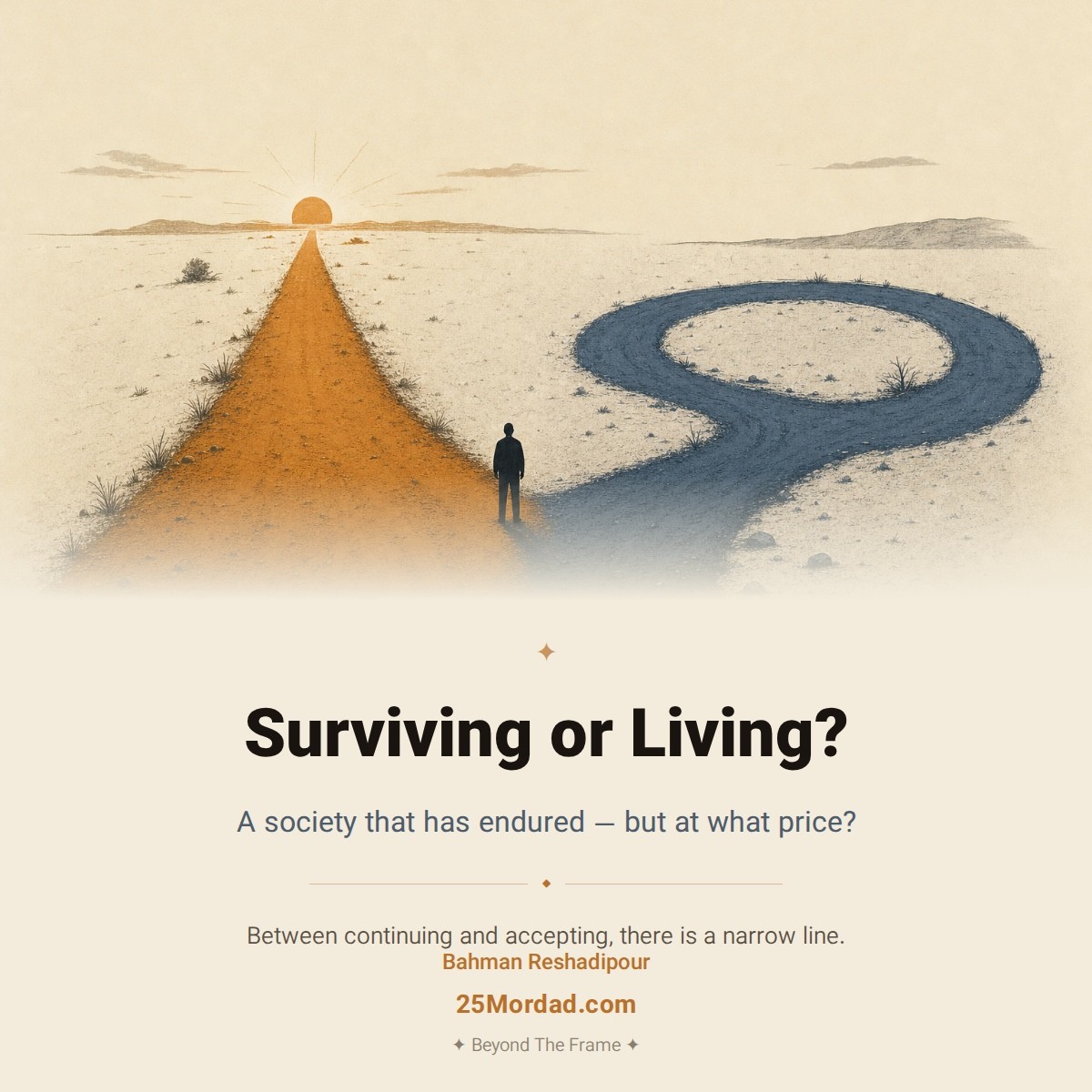
I begin this essay in memory of those who did not settle for merely surviving. Those who gave up part of their life, their peace, or even their own lives so that living might become more possible for others: living with dignity, with choice, with a future one could actually plan for. Those whose names we know. Those whose names have been lost in the noise of days. And those who still continue within the fabric of our everyday lives. A piece that wants to speak of the line between surviving and living has to begin exactly here: with respect for those who illuminated this line at their own cost.
Contents
- Introduction
- Resilience or Normalization?
- Everyday Life: Somewhere Between Coping and Keeping Distance
- Economy: The Clearest Field of Resilience
- When Adaptation Becomes Erosion
- Small Trusts in a Low-Trust Society
- Nonconformity as a Force for Correction
- The Narrow Line: From Endurance to the Possibility of Change
- What Remained, What Was Spent
Introduction
This essay begins with a simple observation: Iranian society has endured. This cannot be ignored. It cannot be dismissed as trivial. It cannot be explained away as mere exhaustion and compulsion. In everyday life, in the economy, in language, in the family, in small networks of trust, in migration, in work, and in humor, people have built ways to carry on.
But enduring does not always mean one thing. Sometimes it is a sign of strength. Sometimes a sign of erosion. Most of the time, both at once. A society can avoid collapse, yet spend, in order not to collapse, the very things that were supposed to build the future: trust, health, quality of life, independent institutions, a clear language, memory, cooperation, and even the capacity to imagine a better life.
For this reason, the question of this essay is not whether the people of Iran are "strong" or "have simply grown used to it." That binary is too simple. The more precise question has three parts: how has Iranian society coped with chronic crises? What has it kept in the process of coping? And what has it spent?
In this essay, resilience is neither praised nor rejected. Resilience only means something once we also see its cost. This essay is about that narrow line. The line between surviving and living. Between carrying on and accepting. Between an adaptation that keeps life going, and an adaptation that slowly shrinks life.
In these years, Iranian society has not only faced crisis. It has tuned itself to crisis. This tuning shows up everywhere: in daily shopping, in jokes, in the relationship with the internet, in the decision to migrate, in the shape of savings, in fear of the future. Even in the image people hold of an ordinary life.
C. S. Holling, one of the central figures in resilience theory within systems thinking, defines resilience as a system's capacity to absorb shock while retaining its core functions. He was talking about nature, not society. But the same sentence can be said of a society: the system may not collapse, but its shape changes so that it does not. [1] This is exactly the question of this essay: what has Iranian society changed within itself in order not to collapse?
The clearest site of this reshaping is the economy. The World Bank has recorded Iran's annual consumer inflation at 44.6 percent for 2023 and 32.5 percent for 2024. [2] Economic pressure is no longer an occasional event that upends life. For many people, it is part of the daily arithmetic.
But society does not only adapt with its wallet. It adapts with its language too. With its jokes. With its threshold of tolerance. With its definition of "normal." An internet that does not work properly, money that loses value a little more every day, a job with no security, a future that cannot be planned for — these gradually move from the level of crisis to the level of habit.
This essay repeatedly draws on experiences from elsewhere: NASA, the Soviet Union, Cuba, Eastern Europe. None of them is Iran, and none of them is a template. They are mirrors. They show something that is hard to see up close.
In Iran, crisis has turned from an event into an environment. A society that tunes itself to its environment gradually forgets that this environment was made, not natural.
Resilience or Normalization?
Resilience and normalization begin in similar ways, but they do not arrive at the same place. Both come from pressure. Both mean that a society cannot collapse anew every day, so part of the crisis has to become bearable. The difference is in the outcome. Resilience keeps society alive and leaves the road to the future open. Normalization also keeps society alive, but it dulls its sensitivity to the crisis.
Research on community resilience makes exactly this distinction. Fran Norris and her colleagues do not consider a community's resilience to be merely "continuing after a crisis." In their view, resilience only means something when it is also connected to mental health, quality of life, social capital, and collective capacity. [3] In other words, if a society endures but its health, trust, and capacity for cooperation are eroded, we cannot comfortably say it has remained resilient.
So a distinction has to be drawn. Adaptation can be healthy. People find new ways to care for one another. Families and friends lighten each other's load. Businesses adjust themselves to new conditions. Language and humor make pressure more bearable. Here resilience still carries a positive meaning, because it keeps the possibility of continuing alive.
But adaptation is not always healthy. Sometimes a society finds a way to reduce today's pressure that makes tomorrow harder. When the family takes the place of supportive institutions, it helps in the short run. If it becomes permanent, the pressure has simply moved from structures onto close relationships. When people work more just to avoid falling behind, they have found a way to survive. If this comes with bodily exhaustion, the erasure of leisure, sleeplessness, and anxiety, it is no longer just resilience. When people learn to get around restrictions, life becomes more possible. If getting around them takes the place of fixing them, society has only become skilled at living within a broken situation.
This is where Diane Vaughan's concept of the "normalization of deviance" becomes useful. In her famous study of the Challenger shuttle disaster, Vaughan showed that at NASA, some warning signs gradually became normal. Something that was at first a sign of a problem, because it repeated many times without leading to disaster, gradually became acceptable. [4] Repeated crisis dulls sensitivity to the crisis itself. What should be a warning becomes part of routine.
The main danger in Iran may not be the crisis itself. It is growing used to the crisis. Inflation, filtering, job insecurity, permanent migration, anxiety about the future. Each of these was a shock at first. After years of continuing, people's minds and behavior adjusted to them. People learned to shop, work, laugh, make plans, leave, or stay within this very condition. This learning is sometimes a sign of strength. But if it makes the underlying situation stop looking like a problem at all, we have entered the territory of normalization.
This is the question the rest of this essay pursues: which part of Iranians' adaptation is still a force of survival, and which part is normalizing a condition that should not be normal?
One criterion separates resilience from normalization: whether adaptation preserves the capacity for the future or spends it. The first keeps the road to living open. The second only stretches out survival. Iranian society has both at once, and the hard task is telling where the line between them runs.
Everyday Life: Somewhere Between Coping and Keeping Distance
From the outside, Iranian society looks highly adaptive. It has coped with inflation, filtering, instability, and successive crises, and still carries life forward. But this picture is not complete. The same society that has adjusted itself to conditions in some areas has kept its distance in others. The question is not whether Iranian society adapts or not. The question is where it copes, where it keeps distance, and how it shows that distance.
In economy and politics, adaptation is more visible. People find ways to run their lives with less income, higher prices, and a more uncertain future. In politics too, society has learned to behave more cautiously, more quietly, more calculatedly. This is not necessarily contentment. Sometimes it only means that the cost of direct opposition is high and its outcome uncertain. Faced with a choice between immediate danger and continuing life, people choose the latter.
Albert Hirschman, in Exit, Voice, and Loyalty, argues that when the quality of an organization or a social order declines, people generally have three options: they leave, they protest, or they stay and endure. [5] In Iran, all three are visible. Migration or withdrawal is exit. Writing, speaking out, and civil resistance are voice. Staying and running one's life within the same condition is loyalty — endurance. These three paths are not separate from one another. A person can stay in the country while their mind is set on leaving. They can tune their everyday life to the situation while their language does not match the official language.
This is where everyday language matters. People do not always protest with language. Sometimes they simply live: they joke, they use irony, they talk about the high cost of living and exhaustion, or they say something the official language cannot say. So not every joke and every idiom should immediately be called "resistance." But this very distance shows that society has not been resolved into the official narrative.
This gap is not only political. Formal Persian and spoken Persian differ from the ground up. Linguists call this situation "diglossia": one language for administration, education, and media; another for life. This has long been the case in the Arab world and in Greece as well. A gap between the official language and the language of life is a well-documented phenomenon, not an Iranian exception.
But in Iran today, this gap is bigger than a linguistic difference. The official language carries the state's narrative: an official morality, an official image of the people, an official definition of the future. This is why everyday language becomes a place where people build a different narrative. James Scott, in his discussion of the "hidden transcript," argues that groups living under the pressure of power usually have two languages. A public language used in front of power. And a more hidden language that stays alive in private, in jokes, in stories, and in irony. [6] This hidden language is not always rebellion. But it shows that there is a distance between the language of power and the language of life.
James Barry, in a chapter on Iran, explains that the official discourse of the Islamic Republic tries to build a central language and a single image of the nation around the revolution and political Islam. This language comes into tension with ethnic, religious, and everyday voices. [7] The gap between the state's language and the people's language is not simply the difference between "formal" and "colloquial." Sometimes it is the difference between two worlds: a world that wants to explain the situation, and a world that lives that situation.
Of course, this gap does not run one way. Power has not stayed outside everyday language either. Where the official language has not been persuasive for part of society, power has entered through channels closer to life: film, television series, sport, music, popular figures, comedy, social media. This is a separate subject in itself and is only touched on here. Everyday language is not untouched territory. People use language, humor, and lifestyle to keep their distance. Power, too, tries to enter this same space and repeat its own narrative through softer means.
This distance can also be seen outside language. Perhaps in ourselves or in those around us. Coping with a falling standard of living, yet resisting the loss of one's personal lifestyle. Taking refuge in close circles, yet distrusting public space. Accepting poor-quality goods and services, yet remaining sensitive about dress, the body, music, travel, the internet, and relationships. These are not verdicts about the whole of society. They are signs.
So Iranian society cannot be explained only through economic indicators or political behavior. Adaptation is visible in economy, consumption, work, and family. Keeping distance is visible in language, humor, lifestyle, the body, the internet, and unofficial narratives. Everyday life in Iran is both a site of adaptation and a site of struggle over meaning. In it, people both find ways to carry on and show their distance from the situation. A society that continues, but does not explain its continuing in the language it is expected to use.
In everyday life, society still stands on the side of living. Language, humor, the body, and lifestyle are places where the official narrative has not fully settled. Though power has not stood idle either, and is moving into this same space.
Economy: The Clearest Field of Resilience
The clearest field of adaptation for Iranian society is the economy. Not because economy matters more than politics and culture, but because economic pressure imposes itself on life every day, every hour. Inflation, rent, the price of food, medicine, transportation, education, healthcare. These bring the crisis down from the level of news to the level of the body and the home. In the economy, crisis is no longer heard. It is felt.
In its recent reports, the World Bank sees Iran's economy under the simultaneous pressure of several factors: structural problems, sanctions, water and energy shortages, disruptions to trade, and political uncertainty. For fiscal year 2025/26 it estimates a 2.7 percent contraction in GDP and writes that high inflation and falling real income are deepening poverty. [8] The International Monetary Fund, in its April 2026 report, forecasts negative growth of 6.1 percent and inflation of 68.9 percent for the same year. [9] These numbers make one thing clear: economic pressure in Iran is not transient. It has become the environment of life.
But the point of this essay is not the numbers. The point is what society does with this pressure. When people face chronic inflation, they do not wait. The shopping basket changes. The brand changes. Lower quality is accepted. Purchase quantities shrink. Large purchases are postponed. Savings move into gold, foreign currency, and goods — into anything that holds its value better. A second and third job becomes normal. Debt, installment payments, price comparison, and the quiet elimination of wants become part of life.
These behaviors are not unique to Iran. The European Central Bank, in its survey of households during periods of high inflation, has observed exactly the same things: people search for better prices, turn to cheaper goods, buy less, draw down savings, or work more. [10] Economic adaptation is a general response to inflation. What is different in Iran is that for many people this is not a short period. It is a chronic, recurring experience.
In such a condition, adaptation is not only visible in shopping behavior. It is visible in wants themselves. Jon Elster, in his discussion of "adaptive preferences," argues that people sometimes adjust their wants to what is available. When something remains persistently out of reach, it may gradually be dropped not only from one's life plan, but from one's imagination of life. [11] When housing, travel, good education, reliable healthcare, leisure, and a future one can plan for keep receding further away, society does not only reduce its consumption. Sometimes it lowers its expectations of life as well.
This is where economic resilience takes on two faces. The first face is people's practical intelligence. Finding a way, cutting costs, building networks of help, changing jobs, learning a new skill, keeping the family alive under pressure. This should not be underestimated. A society that, under economic pressure, still works, builds, and cares for others has a high capacity for adaptation.
Its clearest expression is something every Iranian knows: a culture of repair. In a society where importing parts has become expensive or impossible, repair has grown from a marginal trade into a widespread skill — from household appliances and cars to industrial and medical equipment. The same logic has worked at the industrial scale. Mehdi Majidpour, in a study of Iran's oil, gas, and power industries, shows that sanctions have been a "double-edged sword." They have imposed real costs on companies, while at the same time spurring domestic manufacturing capacity. [12]
But this is exactly where the essay's own criterion has to be applied, because repair does not always mean one thing. Repair born of sanctions is different from repair born of poverty. The first can produce knowledge. Someone forced to redesign a part has learned something they did not know before. The second only stretches out the life of an object until the moment it no longer can be. The criterion for telling them apart is the same one we started with, now in its practical form: does this adaptation add something to future capacity, or does it merely push today onto tomorrow?
When we apply this criterion to Iran's most successful example of self-sufficiency, the picture becomes more complicated. The pharmaceutical industry has long been presented as the main proof of production independence. It is true that nearly all the medicine the country consumes is manufactured domestically. But Peyvand Bastani and colleagues, in a study based on interviews with health-ministry policymakers and managers, show that this very industry has a high dependence on imported raw materials and technology. Banking sanctions have pushed procurement toward intermediaries and the black market. And most importantly, manufacturers no longer have access to the new knowledge of drug production that keeps updating around the world. [13] In other words, Iran manufactures almost all its medicines and still cannot make them. This is substitution, not accumulation. The difference between the two kinds of repair holds. What collapses is the assumption that Iran must necessarily stand on the first side of it.
Cuba shows the same warning on a longer timescale. More than sixty years of sanctions there, too, have built a celebrated culture of repair and improvisation. American cars from the 1950s that still run. Verbs meaning "to jury-rig" and "to improvise" that have entered everyday language. But Javier Corrales, in his study of the survival of Cuba's government, argues that this very half-finished adaptation has itself been a mechanism of survival, not a prelude to change. By controlling who gets access to which profitable sector, the government has kept society fragmented and dependent. [14] Sixty years of everyday creativity have not, at least so far, led to structural change. What has continued unbroken through these same years has been successive waves of migration.
Creativity under pressure has, by itself, no direction. The very capacity that keeps a society on its feet can make the condition producing that pressure more bearable. And, as a result, more durable.
Now let us return to those two faces. The second face is erosive. When people spend their bodies, their minds, their time, and their relationships to hold onto a bare minimum of life, adaptation is no longer only a sign of strength. Food quality declines. Treatment is postponed. Education becomes more stratified by class. Leisure is eliminated. Sleep decreases. Anger increases. The future shrinks to the next few weeks. Society still carries on, but by consuming the very resources that were supposed to build the future.
This erosion has numbers too. Djavad Salehi-Isfahani, drawing on household survey data, shows that the average standard of living in Iran fell by about 17.7 percent between 2010 and 2019, and that per capita consumption returned to its 2002 level. This happened despite government support programs. [15] Society endured through these years. The price of that endurance was nearly two decades.
Sendhil Mullainathan and Eldar Shafir, in Scarcity, explain that scarcity does not only shrink the wallet. It occupies the mind as well. When a person constantly has to manage a shortage of money or time, a large part of their mental capacity is spent on that very management. [16] Economic pressure does not only lower purchasing power. It also consumes concentration, calm, decision-making, and the capacity to plan.
This is why the economy is the clearest field of resilience, but perhaps also the most dangerous field of normalization. Because people are forced to deal with it every day. No one can wait for the economic crisis to be solved before eating, paying rent, or sending their child to school. This very daily compulsion means economic crisis turns into habit faster than any other kind of crisis. Inflation is no longer a number. It is a life skill. Instability is no longer a problem. It is a method of calculation. Declining quality is no longer an exception. It is the new expectation.
Here we have to be careful about moral judgment. This adaptation is not people's free choice. It is a reaction to pressure imposed on life from outside. But its consequences do not stay purely economic. When the future is uncertain, people think about short-term rescue. Deals become more cautious, relationships more instrumental, the circle of help smaller. The pressure descends from the level of state and market and spreads through relations among people.
In the economy, the response is no longer balanced. What we see is more the skill of surviving than a resilience that keeps the road to living open.
When Adaptation Becomes Erosion
Adaptation is not always bad. Without adaptation, life under prolonged pressure falls apart. People have to be able to find a way to carry on. Families have to be able to hold themselves together. Businesses have to be able to cope with new conditions. The problem starts from the point where adaptation, instead of preserving life, begins to spend life itself.
In the literature on crisis and climate change, there is a concept called "maladaptation." It means an adaptation that appears, on the surface, to respond to crisis, but in the long run increases vulnerability, deepens inequality, or reduces future well-being. [17] This concept works for society too. Sometimes a solution that reduces today's pressure deepens tomorrow's problem. To get through today, society spends resources that were supposed to make the future possible: trust, health, education, the quality of relationships, the environment, time, hope, and the capacity for cooperation. In the economy section we saw what this spending looks like at home. Here we need to see what it looks like in the body and the mind.
Bruce McEwen, in his discussion of "allostatic load," explains that the body regulates itself to cope with pressure. This regulation is necessary in the short term. But if the pressure becomes chronic, the very act of adapting turns into bodily erosion. [18] A person's body and a society are not the same thing. But the analogy is precise for this discussion: a society, too, can adjust itself to pressure to such a degree that the adjustment itself becomes erosion.
McEwen is talking about the body, but in Iran this can be traced in the data too. The only national diagnostic survey of mental health in Iran was conducted in 2011, based on clinical interviews with nearly eight thousand people. The result: 23.6 percent of the population aged fifteen to sixty-four had experienced at least one psychiatric disorder in the past twelve months. Close to one person in every four. [19] Another survey, repeated three times using a screening instrument, shows the trend: 21 percent in 1999, 23.4 percent in 2015, and 29.7 percent in 2021. [20] These numbers should be read with caution. Screening is not the same as clinical diagnosis. The last wave was also conducted by phone rather than in person, which could itself explain part of the increase. But the direction of the trend is not in dispute.
Alongside this, we have to look at treatment capacity. In Iran there are 2.4 psychiatrists per hundred thousand people. In the World Health Organization's Mental Health Atlas report, Iran gave no figure at all in response to the question of mental health's share of the health budget. [21] Which means the burden of this erosion has mostly stayed exactly where the family has taken the place of a supportive institution.
Then we arrive at a point where the data itself becomes part of the story. Domestic violence is one of the clearest paths through which outside pressure moves into the home. But its scale in Iran is unclear. Two meta-analyses, conducted on largely the same body of domestic research, have arrived at two irreconcilable figures: one around 49 percent, the other around 66 percent. Neither can be called a national figure. [22] The World Health Organization, in its previous round of estimates, had recorded such a wide range for Iran that it effectively said nothing. In the newer round, there is no figure at all against Iran's name. Just a dash. [23]
This absence is itself a piece of data. A society that no longer measures something has usually already stopped looking at it.
Precisely for this reason, we have to be careful that the picture does not become one-sided. The consumption of antidepressants in Iran grew by about fifty percent between 2006 and 2013. But the level of consumption is still low by international comparison — lower than Germany, the United Kingdom, Sweden, Canada, and many others. [24] The common narrative that presents Iran as "the world's record-holder in pill consumption" does not match the data. The issue is not that Iran is the worst place in the world. The issue is the direction of movement, and what that movement is spending.
A large part of this erosion is never recorded in any survey at all. Growing used to lower quality. Gradually lowering one's expectations of life. Accepting bad services. Numbness toward environmental destruction. Or passing pressure onto the people closest to us.
One of the most dangerous forms of erosive adaptation is the shortening of the moral horizon. When people are under constant pressure, they sometimes think only about getting through today. The seller passes the market's pressure on to the customer. The employer passes the crisis's pressure onto the worker. The family passes economic pressure onto its closest relationships. To protect themselves, people narrow the circle of those they feel responsible for. The bitterest form of this transfer is domestic violence — the very thing whose scale, as we saw, we do not even know. Here the issue is bigger than individual ethics. Prolonged pressure narrows the circle of people a person considers themselves responsible toward.
From an evolutionary angle, virtue is not simply a matter of someone being able to save themselves in the short term. A behavior is virtuous when it increases a group's capacity for survival, cooperation, learning, and building the future. By this standard, an adaptation that enables a society to care for one another and correct its own errors is a social virtue. An adaptation that saves only an individual or a small group while making everyone else pay the cost is not.
This is exactly where resilience is hollowed out from within. Its appearance is still that of continuing. People still work, still shop, still keep the family running, still joke. But beneath this continuation, things are quietly being spent. People think less about the future. They trust strangers less. They fight less for public quality.
So erosive adaptation means society still continues, but by spending things that should not have been spent. Life is preserved, but its quality declines. The crisis is managed, but sensitivity to the crisis falls. Today passes, but tomorrow becomes poorer. And poorer not only in money.
In Iran, adaptation no longer spends only the wallet. It spends health and the moral horizon too. Part of this cost has been measured, and the larger part is not even counted. This is the cost of surviving, and it is paid out of the account of living.
Small Trusts in a Low-Trust Society
One of the things that changes under the pressure of prolonged crises is the shape of trust. Society does not only adapt to prices and shortages. It adapts to uncertainty too. When the future is unclear, the law is unpredictable, and institutions do not create a sense of security, people take refuge in what is closer to them: family, friends, relatives, acquaintances, a reliable coworker, a trustworthy neighbor. Small circles within which something can still be carried forward with relative confidence.
This retreat should not be simply condemned. In many situations, exactly these small trusts keep life going. Lending money, caring for children, referring someone to a job, vouching for someone, helping with medical care, giving someone a place to stay, offering emotional support in hard moments — all of these come from these close circles. Without these networks, the pressure of crisis would be heavier for many people. So the issue is not that family trust is bad. The issue starts from the point where trust is confined to these small circles and never reaches the level of society at large.
Robert Putnam, in his discussion of social capital, distinguishes between two kinds of ties. Bonding ties, which connect similar and close people to one another: family, friends, familiar groups. And bridging ties, which connect people and groups that do not come from the same circle. [25] A society that keeps only its close ties may be strong in survival, but it grows weak in public cooperation. Trust is not merely a personal feeling. It is the infrastructure of cooperation.
In Iran, this distinction can be felt in everyday experience. A person trusts family and close friends. But in dealing with strangers, in administrative work, in collective participation, or in relation to institutions, they are cautious and defensive. This is not a moral trait of individuals. It is a reaction to an environment in which abuse, instability, and unanswered appeals have been widely experienced. A population-based survey in Tehran, with a sample of more than 31,000 people, measured trust at different levels: from family and friends to neighbors, coworkers, one's own ethnic group, and the public at large. This very breakdown shows that trust is not a single, uniform thing. In the same survey, about 31 percent of respondents fell into the low social-capital category. [26]
The familiar experiences of everyday life say the same thing. Handing a task to someone you know. Looking for "someone inside the office." Buying from someone who came recommended. Getting help through a connection rather than through the formal process. These cannot simply be called corruption or backwardness. Sometimes they are ways of reducing risk in an environment where the formal mechanism does not build enough trust. But if these very survival routes become permanent and widespread, they gradually weaken merit, fairness, and public trust.
Alena Ledeneva, in her study of informal networks in Soviet and post-Soviet Russia, speaks of a phenomenon called the "economy of favors." A network of relationships and acquaintances that people used to access goods and services that were difficult or unreliable to obtain through official channels. [27] When the formal system becomes ineffective, informal relations are no longer the margin of life. They become a way of life. In the short run they solve the problem. In the long run they make the very system we distrust even less trustworthy.
But not all informal networks carry the same weight, and lumping them together inverts the picture. When someone approaches an acquaintance for an administrative task, they are reducing risk in an uncertain environment. But above this level are networks that hold the formal channel itself in their hands: access to foreign currency at a preferential rate, cheap credit, import licenses. Kevan Harris, in his study of privatization in Iran, shows that what has taken place under that name has been more a transfer of assets to a set of quasi-state institutions than a genuine handover to the private sector — banks, pension funds, foundations, affiliated contractors. [28] These two levels are not the same. An ordinary person who turns to an acquaintance is reacting to distrust. A network that holds the formal channel is producing distrust. One is the result of the problem, the other its cause.
Houtan Shambayati, comparing Iran and Turkey, takes this one step further. In his view, a rent-dependent economy itself blocks the formation of independent interest groups. When each person's share of resources depends more on their relation to power than on their collective bargaining strength, guilds, unions, and professional associations become, at root, pointless. [29] Meaning the very rent that erodes public trust has already removed the tool that could repair it. And this same experience — that the rule is not applied equally to everyone — turns public distrust from a habit into a conclusion.
Mark Granovetter, in his theory of "the strength of weak ties," makes an important point. Weak ties — relationships that are not as intimate as family and close friends — connect different groups of society to one another. They carry information, opportunity, and cooperation from one circle to another. [30] A society cannot stay large on close ties alone. If trust remains only within small circles, society fragments from within. Everyone leans on their own group, and the connection among groups weakens.
Economic pressure intensifies exactly this. When people are constantly worried about tomorrow, they take on less of the risk of trusting a stranger. When resources shrink, competition becomes harsher. When the experience of injustice repeats, people look for private routes instead of public rules. The result is that society is still full of help and care, but mostly within close circles.
This condition has two faces. Its positive face is that family, friendship, and close networks act like shock absorbers. In the absence of adequate support, these very networks prevent many people from falling all the way down. Its worrying face is that if trust is confined to those close to us, public cooperation becomes difficult. Collective work becomes harder. Civil institutions grow weaker. Merit gives way to connection. Society becomes, instead of one expansive "we," a collection of small and cautious "we's."
Elinor Ostrom, in her work on the governance of common resources, showed that durable cooperation is not built by good intentions alone. People cooperate better when clear rules, reliable monitoring, the possibility of participating in decisions, and mechanisms for resolving disputes all exist. [31] Public trust, too, is not built by moral exhortation. For a society to trust strangers, it needs institutions, rules, and a repeated experience of fairness.
So the retreat into small trusts carries two meanings. Part of it is a sign that relationships are still alive. Part of it is a sign of the retreat of public trust. People still care for one another, but mostly for those they know. They still cooperate, but mostly when the other side has already been tested or belongs to a familiar circle. Close circles save life. But if they remain the only shelter, the possibility of building a shared future weakens.
Trust, too, is moving in the same direction. Small circles have kept life going, but instead of serving as a bridge to public trust, they have taken its place. A society that works mostly through acquaintance is strong in surviving and incapable of building a future.
Nonconformity as a Force for Correction
If adaptation is necessary for continuing, nonconformity is necessary for correction. A society that never adapts falls apart under prolonged pressure. A society that always adapts gradually loses its capacity to recognize error. Of course, not all nonconformity is good. Blind, scattered, or merely destructive nonconformity can itself be part of the erosion. But there is a kind of nonconformity that does the work of correction: it reminds us that the existing situation is not natural and not final.
In this sense, nonconformity is not only street protest or political opposition. Sometimes it is visible in holding onto a standard. In refusing humiliation. In insisting on quality. In narrating an experience the official language does not want to see. In lifestyle, in the body, in humor, in art. In refusing a lie that is meant to become normal. James Scott, in Weapons of the Weak, speaks of "everyday forms of resistance" — small, unheroic behaviors that do not resemble revolution, but show that people have not become one with the dominant order. [32] So we should not only look for the great moments of nonconformity. Part of society's distance from the situation is kept alive in small, everyday behaviors.
But right here a line has to be drawn. Not every different behavior is resistance. Not every joke is protest. Not every lifestyle is political action. If we call everything resistance, we have emptied the concept of resistance of meaning. It is better to say these are signs. Signs that society has not fully become one with the situation. That a distance still exists. That another language still exists.
Václav Havel, in his famous essay "The Power of the Powerless," written in 1978 in communist Czechoslovakia, speaks of "living in truth." He did not mean that every citizen has to become a political hero. His point was simpler and deeper. In a system that asks people to take part in an official performance, refusing to repeat that performance is itself a form of power. A dissident does not have to be a professional political activist. Any citizen who tries to "live in truth" enters this distance in some way. [33]
The analytical parallel is exactly here. Ideological orders do not run on force alone. They ask people to take part in language, rituals, images, and official narratives too. In such a condition, nonconformity is not only one big "no." Sometimes it means people refuse to let the official language claim the whole of their lived experience.
The experience of Eastern Europe is useful from the same angle. Societies that emerged from under communist order did not all take the same path. Some rebuilt themselves faster. Some fell into corruption, populism, mafia rule, or new forms of authoritarianism. The difference was not only in the severity of past repression. It was also in what society had kept under pressure: independent institutions, a memory of resistance, networks of trust, a critical language, experience of organizing, the capacity for cooperation.
Juan Linz and Alfred Stepan, in their discussion of democratic transition, argue that moving past a nondemocratic regime does not depend only on changing the government or holding elections. For the transition to become durable, several fields need capacity: civil society, political society, the rule of law, an effective bureaucracy, and an economy not completely dissolved into political power. [34] In other words, nonconformity becomes a force for correction when it turns from an individual reaction into a social capacity.
Poland's example is instructive from this angle. Grzegorz Ekiert and Jan Kubik, in their study of rebellious civil society in Poland, show that protest and social organizing — especially the experience of the Solidarity movement — did not only play a role in the collapse of communist order. It also affected the consolidation of democracy afterward. [35] Social anger, if it does not turn into network, memory, organization, demand, and shared language, is spent quickly. If it builds these capacities, it can later become part of reconstruction.
In Iran, in recent years, nonconformity has not been visible only in formal politics. It has been visible in styles of dress. In the body, in the relationship with the internet, in migration, in humor, in art. In the language of generations and in women's narration of themselves. In sensitivity to humiliation, and in the effort to maintain personal and professional standards. None of these leads by itself to structural reform. But all of them show one thing: society has not yet fully merged with the normalization of the crisis.
The core issue is how these nonconformities move from the level of a sign to the level of a capacity. If they remain only scattered anger, they are worn away. If they turn only into individual migration, part of society's energy leaves the country. If they remain only in jokes and irony, they make the crisis more bearable without changing it. But if they turn into precise language, networks of trust, civic cooperation, clear demands, collective memory, and small institutions, they can take on a corrective role.
The same standard of virtue that applied to adaptation works here too. Nonconformity is valuable when it increases a society's capacity for survival, cooperation, learning, and building the future. Nonconformity that only destroys, only negates, or only separates the individual from the collective is not a virtue. But nonconformity that exposes error, refuses to normalize a lie, keeps the possibility of cooperation alive, and pushes society to correct itself is a vital force.
For this reason, society needs both forces. Adaptation to survive, nonconformity to stay healthy. If it only adapts, it absorbs the crisis into itself. If it only refuses to adapt, it loses the capacity to continue. The difficult point is holding onto both at once. Continuing without total surrender. Keeping distance without collapse. Protesting without losing the capacity for cooperation.
So nonconformity, in this essay, does not mean opposition for its own sake. Nonconformity means society still has a mechanism for detecting error. It can still say that this quality of life is not enough. That this official language is not the whole truth. That this humiliation is not natural. That this shrunken future must not be a settled fate.
Nonconformity is not scarce in Iran. What is scarce is a path that turns nonconformity into a collective force. And this path has not stayed closed on its own. It has been kept closed.
The Narrow Line: From Endurance to the Possibility of Change
By now the question is no longer how resilient Iranian society is. We already know the answer to some degree: very. A society that has continued for years through inflation, uncertainty, political pressure, filtering, migration, and successive crises has a high capacity for adaptation. The more important question is: how far is this resilience a virtue, and at what point does it turn into the normalization of a condition that should not be normal?
The line between the two is not always clear. People cannot live every day at the full intensity of the crisis. To keep going, they have to make part of the pressure bearable. They have to laugh, work, raise children, lend and borrow, and start over. This part of adaptation is a condition of survival. But if this very endurance makes society stop seeing the decline in its quality of life, treat humiliation as natural, or accept a shrunken future as fate, resilience has changed its meaning from within.
Here we can draw on Amartya Sen. Sen, in his discussion of "capabilities," argues that development is not only a matter of income or survival. What matters is what possibilities human beings have for choosing, acting, and building a life they have reason to value. [36] This view lifts resilience above the level of mere survival. A society may endure, but if the possibility of choice, planning, participation, and dignity within it shrinks, we cannot defend it simply with the word resilience.
Avishai Margalit, in The Decent Society, says that a decent society is one whose institutions do not humiliate people. [37] In prolonged crises, the danger is not only poverty or uncertainty. The danger is that humiliation, too, becomes normal. People grow used to bad services, to disrespect, to being left unanswered, to being ignored. And they gradually come to imagine that this level of life is natural.
From this angle, resilience is valuable when it preserves dignity. Not when it makes people more accustomed to humiliation. If a society only learns how to live with lower quality, greater instability, and a shorter horizon, it is still alive. But its life has become smaller. The core issue is exactly this quiet shrinking of life. Something that is sometimes invisible in the numbers, but settles into people's bodies, language, relationships, imagination, and expectations of the future.
So the question is: in getting through today, what is left of tomorrow? If, to survive, public trust is destroyed. If, to continue, everything is reduced to family and acquaintance. If, to endure, an independent language is confined only to jokes and irony. If, to survive, moral and professional standards decline. If, to escape the pressure, a society's best minds scatter abroad. Then society may still endure, but its capacity to rebuild grows weaker.
Out of this discussion, four concerns emerge. Not a complete list, but the things that have shown themselves most along the path of this essay.
First, public trust. A society that endures only within close circles is still alive, but its shared horizon shrinks. Family, friends, and acquaintances can keep life going through hard days. But a shared future cannot be built from these circles alone.
Second, the spaces in which society practices cooperation. An association, a guild, a local group, a professional body, an independent media outlet, a class, a workshop. These small spaces are exactly what remind society that it is something more than a collection of isolated individuals. If they weaken, both anger and hope stay scattered. A shared feeling exists, but it does not turn into durable collective action.
Third, language. If people cannot narrate their own experience outside the official language of power, even their pain gets explained through words that are not their own. A society that loses its independent language does not only lose the power to speak. It gradually loses the power to understand its own experience as well. Humor, personal narrative, literature, art, and even the simple act of naming experiences matter for exactly this reason.
Fourth, historical memory. A society that forgets what it has been through finds it easier to accept the same mistakes as normal all over again. Memory means sensitivity to repetition, not a return to the past. Knowing which pressures are not new, which promises are repeated, and which adaptations have already shrunk the future before.
All four concerns come back to one thing: the capacity to cooperate with people who are not like us. A shared future becomes possible when people can work together beyond kinship, friendship, religion, ethnicity, or prior acquaintance.
But here we have to be precise, or the argument drifts toward blaming society — as if people were at fault for not building associations and guilds. This capacity has not only been eroded under pressure. Where it should have been practiced, it has been kept closed. In the discussion of rent, we saw that a rent-dependent economy renders guilds and unions pointless. But the story is not only about becoming pointless. It is also about being prohibited. The International Labour Organization has two foundational conventions on freedom of association and the right to organize, numbers 87 and 98. Iran has ratified neither. The same organization's Committee on Freedom of Association has repeatedly asked the Iranian government to amend labor law so that the plurality of workers' organizations is recognized. [38] The telling point is that the same request has also been made regarding employers' organizations. Meaning the restriction is not aimed at one particular class. It is aimed at the very possibility of independent organizing.
Even where an organization does obtain a license, the license itself does the work of limitation. Shahram Akbarzadeh and colleagues examined several women's NGOs, all of them formally registered. These organizations provide services, training, and support, but consciously keep their distance from demanding legal change. Not out of reluctance. To protect that very license and that very margin of safety. [39]
This distinction is decisive. Earlier we quoted Elinor Ostrom saying that durable cooperation needs clear rules and the possibility of participating in decisions. But there is a prior condition that Ostrom takes for granted: that people are even allowed to make their own rules. A society whose intermediary institutions have been worn down can rebuild them, because it has the experience of building. A society that has not been allowed to build for decades faces, on the day of reconstruction, something harder than ruins: the lack of practice.
This is exactly where we can understand why unconditional praise of resilience is dangerous. When we speak of people's resilience, we may unintentionally beautify the pressure. We may end up praising the people who have been forced to live with the crisis, instead of asking about the structures that created the crisis in the first place. This praise, if unguarded, turns into a kind of soft cruelty: admiring those who endure under pressure, without asking why they should have to endure this much in the first place.
But on the other side, ignoring resilience is also a mistake. Iranian society has not been passive in the face of pressure. Within this very condition, it has built ways, built language, built networks, built humor, built care. In many moments it has not let life be run entirely by the dictates of crisis. This capacity is real and should be seen. The issue is that this capacity should not be spent entirely on endurance. If all of society's energy is spent adapting to the condition, nothing is left for changing the condition.
Hope comes from exactly this point. Not from simple optimism, not from the idea that society will find the way to salvation on its own. Hope comes from the fact that society is still sensitive to its own erosion. It can still tell the difference between continuing and accepting.
So perhaps the question should be asked this way: what should we no longer adapt to? To a declining quality of life? To public distrust? To the erasure of the future from everyday imagination? To a language that wants to present the crisis as natural or without alternative? To the idea that ordinary life simply means surviving?
The freshest example of this very question is the war. Inflation, filtering, and job insecurity have settled into everyday life for years now, and we mostly see the results of having grown used to them. War has not yet reached that stage. We do not know how long it will last. We do not know whether it is close to ending or will drag on for years to come. This very not-knowing turns the war into a live test of this essay — a place where normalization can be watched not in the past, but in the process of forming in the present. If the war goes on for a long time, society will most likely do what it did with the economy and with politics. It will build a new language. It will build new jokes. It will find a new calculation for staying, leaving, and spending. It will raise its threshold of tolerance. Part of this is a condition of survival and should not be blamed. But if this very adaptation reaches the point where war slides from an exceptional condition into the ordinary background of life, we will pay its cost out of the future. Like every other erosive adaptation.
But here there is an important difference. War, unlike most of what has come in this essay, is not something society can end by its own decision. Its beginning and end lie in the hands of forces that act far beyond the will of the people. But there is a distance between "ending the war" and "determining one's own relation to the war." Society may not be able to decide when the war ends. But it can decide what it will not hand over in the meantime: its language, its standards, its sensitivity to humiliation, its capacity for cooperation, and its recognition that the present condition is exceptional, not natural.
And perhaps the very feeling that "there is nothing we can do" is itself part of that same adaptation. Prolonged pressure does not only lower a person's expectations. It also narrows the circle of what they consider possible. The line between "this is genuinely beyond our control" and "this has repeated so much that it no longer occurs to us that something could be done" is not always clear. And this very unclarity is one of the most precise places that needs watching.
Society has to be adaptive enough not to fall apart, yet nonconforming enough not to normalize the crisis. It has to be able to cope with today, without spending tomorrow on today.
Hope does not lie in resilience itself. It lies in the capacity to recognize the moment when one should no longer endure. The moment when surviving no longer leads anywhere toward living.
What Remained, What Was Spent
From the outside, people's continuing looks like strength. To some degree it is. But up close, this strength is not calm and unwounded. Society is still standing. But its standing has to be examined carefully: with what it has kept, and with what it has spent to keep itself standing.
This same society has not become one with the crisis. It still builds its own language. It still jokes. It still does not fully accept the official narrative. It still keeps distances alive in lifestyle, in the body, in art, in memory, in small acts of care, and in everyday nonconformities. These distances are not always large or sufficient. But they show that normalization is not complete.
So the issue is not only how Iran has endured. The issue is which direction this endurance is heading. This is not a question a single essay can fully settle. What an essay can do is point to the danger in its correct form. The main danger is not sudden collapse. The danger is quieter: that the future shrinks so much that its absence stops being noticed.
Iranian society has stayed alive, and this is no small achievement. But surviving must not be mistaken for living. And the more the two are taken as one and the same, the harder it becomes to turn back.
References
- C. S. Holling, "Resilience and Stability of Ecological Systems" (1973). annualreviews.org
- World Bank, "Inflation, consumer prices (annual %) — Iran, Islamic Rep." data.worldbank.org
- Fran H. Norris et al., "Community Resilience as a Metaphor, Theory, Set of Capacities, and Strategy for Disaster Readiness" (2008). doi.org
- Diane Vaughan, "The Challenger Launch Decision: Risky Technology, Culture, and Deviance at NASA" (1996). psnet.ahrq.gov
- Albert O. Hirschman, "Exit, Voice, and Loyalty: Responses to Decline in Firms, Organizations, and States" (1970). hup.harvard.edu
- James C. Scott, "Domination and the Arts of Resistance: Hidden Transcripts" (1990). yalebooks.yale.edu
- James Barry, "Monologism and Authority in Iran: Ethnic and Religious Dissonance in the Islamic Republic," chapter in The Monologic Imagination (Oxford University Press). academic.oup.com
- World Bank, "Iran Overview." worldbank.org
- International Monetary Fund, "World Economic Outlook, April 2026: Global Economy in the Shadow of War." imf.org
- European Central Bank, "Economic Bulletin — Households' Response to High Inflation" (2024). ecb.europa.eu
- Jon Elster, "Sour Grapes: Studies in the Subversion of Rationality" (1983). cambridge.org
- Mehdi Majidpour, "The Unintended Consequences of US-led Sanctions on Iranian Industries," Iranian Studies 46(1): 1–15 (2013). doi.org
- Peyvand Bastani et al., "Challenge of Politico-Economic Sanctions on Pharmaceutical Procurement in Iran: A Qualitative Study," Iranian Journal of Medical Sciences 47(2): 152–161 (2022). pmc.ncbi.nlm.nih.gov
- Javier Corrales, "The Gatekeeper State: Limited Economic Reforms and Regime Survival in Cuba, 1989–2002," Latin American Research Review 39(2): 35–65 (2004). doi.org
- Djavad Salehi-Isfahani, "The impact of sanctions on household welfare and employment in Iran," Middle East Development Journal 15(2): 189–221 (2023). doi.org
- Sendhil Mullainathan and Eldar Shafir, "Scarcity: Why Having Too Little Means So Much" (2013). iq.harvard.edu
- Intergovernmental Panel on Climate Change (IPCC), "Sixth Assessment Report, Working Group II, Annex II: Glossary" (2022). ipcc.ch
- Bruce S. McEwen, "Protection and Damage from Acute and Chronic Stress: Allostasis and Allostatic Overload and Relevance to the Pathophysiology of Psychiatric Disorders," Annals of the New York Academy of Sciences 1032: 1–7 (2004). doi.org
- Vandad Sharifi et al., "Twelve-month Prevalence and Correlates of Psychiatric Disorders in Iran: The Iranian Mental Health Survey, 2011," Archives of Iranian Medicine 18(2): 76–84 (2015). journalaim.com
- Ahmad-Ali Noorbala et al., surveys of the mental health status of Iran's adult population — three waves, 1999, 2015, and 2021 (British Journal of Psychiatry 184: 70–73, 2004; Archives of Iranian Medicine 20(3): 128–134, 2017; Archives of Iranian Medicine 25(4): 201–208, 2022). doi.org
- World Health Organization, "Mental Health Atlas 2024 — Country profile: Iran, Islamic Republic of" (2025). who.int.pdf)
- Two meta-analyses of domestic research on domestic violence in Iran, with irreconcilable results: Hamideh Hajnasiri et al., "Domestic Violence Among Iranian Women: A Systematic Review and Meta-Analysis," Iranian Red Crescent Medical Journal 18(6) (2016; pooled prevalence 66%) — pmc.ncbi.nlm.nih.gov; and Afshin Kharazmi et al., "Systematic Review and Meta-Analysis of the Lifetime Prevalence of Domestic Violence against Women in Iran," Asian Women 31(4): 77–98 (2015; pooled prevalence 48.9%). doi.org
- World Health Organization, "Violence against women prevalence estimates, 2023" — Annex 10, Table A10.1, where Iran's row is recorded with no estimate. who.int
- F. Soleymani et al., "Pattern of Antidepressant Utilization and Cost in Iran from 2006 to 2013 in Comparison with Other Countries," Journal of Epidemiology and Global Health 8(3–4): 213–219 (2018). doi.org
- Robert D. Putnam, "Bowling Alone: The Collapse and Revival of American Community" (2000). beyondintractability.org
- Mohsen Asadi-Lari et al., "Identifying associated factors with social capital using path analysis: A population-based survey in Tehran, Iran — Urban HEART-2," Medical Journal of the Islamic Republic of Iran 30: 414 (2016). pmc.ncbi.nlm.nih.gov
- Alena V. Ledeneva, "Russia's Economy of Favours: Blat, Networking and Informal Exchange" (1998). books.google.com
- Kevan Harris, "The Rise of the Subcontractor State: Politics of Pseudo-Privatization in the Islamic Republic of Iran," International Journal of Middle East Studies 45(1): 45–70 (2013). doi.org
- Houtan Shambayati, "The Rentier State, Interest Groups, and the Paradox of Autonomy: State and Business in Turkey and Iran," Comparative Politics 26(3): 307–331 (1994). jstor.org
- Mark Granovetter, "The Strength of Weak Ties" (1973). journals.uchicago.edu
- Elinor Ostrom, "Governing the Commons" (1990); Nobel Memorial Prize in Economic Sciences, 2009. nobelprize.org
- James C. Scott, "Weapons of the Weak: Everyday Forms of Peasant Resistance" (1985). yalebooks.yale.edu
- Václav Havel, "The Power of the Powerless" (1978). europarl.europa.eu
- Juan J. Linz and Alfred Stepan, "Problems of Democratic Transition and Consolidation" (1996). blogs.worldbank.org
- Grzegorz Ekiert and Jan Kubik, "Rebellious Civil Society: Popular Protest and Democratic Consolidation in Poland, 1989–1993." press.umich.edu
- Amartya Sen, "The Capability Approach," Stanford Encyclopedia of Philosophy. plato.stanford.edu
- Avishai Margalit, "The Decent Society" (1996). hup.harvard.edu
- International Labour Organization — ratification status of Conventions No. 87 (Freedom of Association and Protection of the Right to Organise, 1948) and No. 98 (Right to Organise and Collective Bargaining, 1949) in the NORMLEX database, and Committee on Freedom of Association Case No. 2508 concerning Iran. normlex.ilo.org
- Shahram Akbarzadeh, Rebecca Barlow, and Susan Nasirpour, "Registered NGOs and advocacy for women in Iran," Third World Quarterly 42(7): 1475–1488 (2021). doi.org