Iran in a Compressed Historical Moment
Between 1953, 1979, and the Scenarios Ahead
Published on May 23, 2026
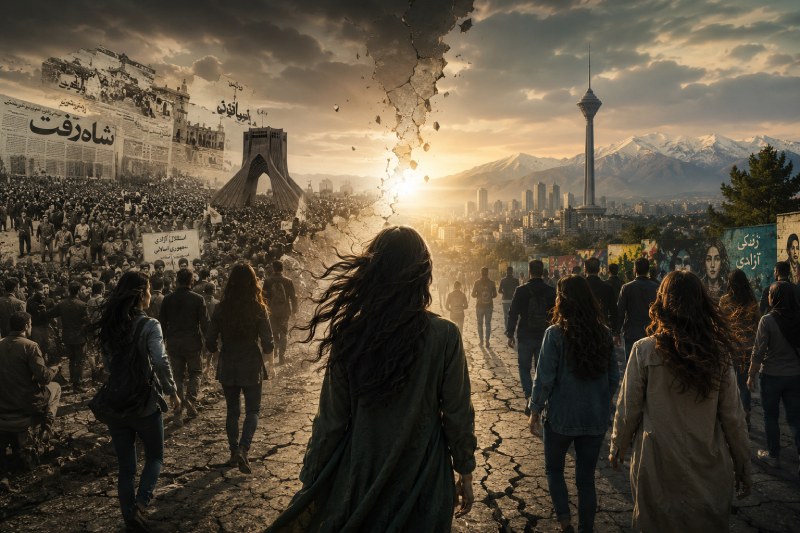
Iran today is not facing just one crisis. What we are seeing is a stack of simultaneous crises: external pressure, economic breakdown, a legitimacy gap, social erosion, the nuclear file, the risk of regional confrontation, and the Strait of Hormuz question. Any one of these would be heavy for a country on its own; in Iran today, they overlap and produce what looks like a compressed historical moment.
To understand such a moment, day-to-day analysis is not enough. We need altitude, not only headlines. History does not repeat exactly, but it often repeats rhythms and structures. Iran today cannot be mapped perfectly onto a single period, but the closest picture is this: geopolitically, it resembles the 1951-1953 crisis; socially and in terms of domestic legitimacy, it carries features of the years leading to 1979.
Part I: The Macro Historical Frame
The oil nationalization crisis and the August 1953 coup were among the most important turning points in modern Iranian history. In that period, Iran tried to remove a vital global lever from foreign control. Oil was not merely an economic resource; it was power, sovereignty, pressure, and bargaining capacity. Mossadegh's government sought to anchor national control over national resources. But that choice pushed Iran into direct confrontation with Britain and then the United States.
The result was simultaneous activation of external pressure, oil sanctions, declining state income, domestic political fragmentation, economic stress, rivalry between court and government, mobilization of competing political forces, and Western fear of instability inside Iran. The crisis was not only economic, not only political, and not only foreign. These dimensions fused and eventually led to August 1953.
Today, Iran again holds strategic levers, but this time not only oil. The Strait of Hormuz, the nuclear program, capacity to disrupt energy markets, regional networks, missiles, and asymmetric military power have all become bargaining instruments. As oil placed Iran at the center of global power politics in the early 1950s, Hormuz and the nuclear file now place Iran at the sensitive core of regional and global order.
That is the first half of the picture. The second half is closer to 1979. In the years before the revolution, the Shah's regime still looked strong on the surface: army, intelligence apparatus, oil money, Western backing, and an intact central state. But underneath, a deep fracture had opened between state and society. A large part of society no longer saw the regime as representative. Political repression, inequality, corruption, class distance, social humiliation, and blocked reform had gradually eroded legitimacy.
Today, Iran is not only under external pressure. Inside the country, inflation, declining purchasing power, social anger, deep distrust of the state, repression, large-scale emigration, youth despair, and cultural distance between society and governing ideology have produced a layer reminiscent of pre-revolution years. The key difference is that in 1979 protests became a nationwide, coordinated movement with shared symbols. Today, discontent is broad, but its conversion into organized political power is still uncertain.
In short: today's Iran resembles 1953 geopolitics with a society that resembles 1979. From outside, the crisis resembles 1953 logic: strategic levers, sanctions, bargaining, energy, and great-power anxiety. From inside, it echoes late-Pahlavi dynamics: exhaustion, distrust, anger, and a widening gap between state and society. But outcomes are not predetermined. History offers patterns, not prophecy.
Part II: Possible Scenarios and Their Triggers
Instead of one deterministic prediction, it is more useful to map multiple scenarios. Each scenario is a possible path, usually activated by a trigger.
Baseline condition: Iran is in a manageable but highly dangerous crisis. Where it moves depends on what becomes dominant: external pressure, domestic anger, elite fragmentation, economic erosion, or a combination of all of them.
Scenario 1: Controlled Compromise
In this path, Iran and external powers reach a temporary arrangement. The aim is not to resolve everything, but to prevent explosion. Hormuz stays open, military tension decreases somewhat, nuclear talks move onto a longer track, and parts of sanctions pressure may be reduced in staged and limited ways.
Domestically, the state presents this as resistance-driven victory. In reality, it may be a tactical retreat marketed as success. The trigger appears when the hard core of power concludes that direct confrontation threatens regime survival more than limited compromise does. In this case, the regime does not collapse; it may even tighten internal security after external pressure drops.
Scenario 2: Domestic Movement in the 1979 Pattern
Here, the center of gravity shifts from outside to inside. The main issue stops being the U.S., Israel, Hormuz, or negotiations, and becomes society versus state.
This scenario emerges when dispersed grievances connect: workers, retirees, students, women, middle classes, bazaars, teachers, ethnic regions, and small cities. If these remain fragmented, they are containable. If they synchronize, a different phase begins. Potential triggers include symbolic or mass killings of protesters, deeper currency collapse, inability to pay salaries, shortages of essentials, major corruption scandals, or a national shock interpreted as state incompetence.
Anger alone is insufficient. Historical transformation requires coordination. If protest links to strike, strike to elite fractures, and elite fractures to command crisis, the 1979-type scenario gains force.
Scenario 3: Forced Internal Reconfiguration
This path appears if parts of the power structure conclude that current strategy is endangering the whole system. The system may then attempt self-preservation through personnel changes, softer foreign policy, controlled reforms, or managed political recalibration.
Scenario 4: Retreat Through Exhaustion
In this equivalent of the 1988 logic, the regime may accept a hard deal not from strength but from fatigue and urgency. The trigger is material erosion: shrinking revenues, trade-management failure, currency shortages, export disruptions, fiscal stress, delayed salaries, and pressure from key partners for de-escalation.
Scenario 5: Fragmentation of Central Authority
This is the darkest path and less likely in the short term, but highest risk if activated. It usually requires a compound shock: external conflict, economic freefall, regional protests, security-force splits, and inability to manage multiple crises simultaneously.
Which Scenario Is More Likely?
In the short term, the more likely paths are controlled compromise or retreat through exhaustion. A 1979-type rupture becomes more plausible only when economic crisis and repression connect to wide strikes and elite splits.
The fragmentation scenario remains less likely but most dangerous, because then the issue is no longer only governance, but territorial integrity, national security, and the country's future architecture.
The Core Signal To Track
The decisive question is not only "Will there be war?" or "Will there be a deal?" A deeper question matters more:
Is the crisis still primarily state-versus-external pressure, or is it transforming into state-versus-society combined with fractures inside power?
As long as the hard core of power remains cohesive and security forces obey, the system can absorb very heavy pressure. But if pressure from below synchronizes with fragmentation above, history in Iran can accelerate faster than outside observers expect.
Ultimately, this crisis will not be decided only at negotiating tables. Streets, bazaars, factories, universities, security institutions, and internal power rifts are equally decisive in determining where history turns next.